The Rolex Buying Guide
Buying a Rolex should be exciting, not stressful. Whether it’s your first or your fifth, a handful of fundamentals separate a great purchase from a regrettable one — and none of them require insider access. They just take a little patience and the right questions. Here’s how we’d guide a friend through it.
Start with the reference, not the name
“Datejust,” “Submariner,” “GMT-Master II” — these are model families, not watches. A single family can span dozens of distinct watches once you account for case size, bezel, dial colour, bracelet and era. The reference number, usually engraved between the lugs at the 12 o’clock side, tells you exactly what you’re looking at.
Get fluent in the reference of the watch you want before you shop. It’s the first thing we confirm on every piece that comes through the studio, because it anchors everything else: the correct dial and hands, the right bracelet and clasp, the period-correct details, and — crucially — the fair market price.
How to read condition
Condition is where value is won or lost, and most of it comes down to whether a case has kept its original geometry. Look at the lugs and the bevels that run along their edges: sharp, defined lines mean a watch that hasn’t been over-polished. Soft, rounded lugs and shallow lug holes are the tell-tale signs of a case that’s been buffed one too many times.
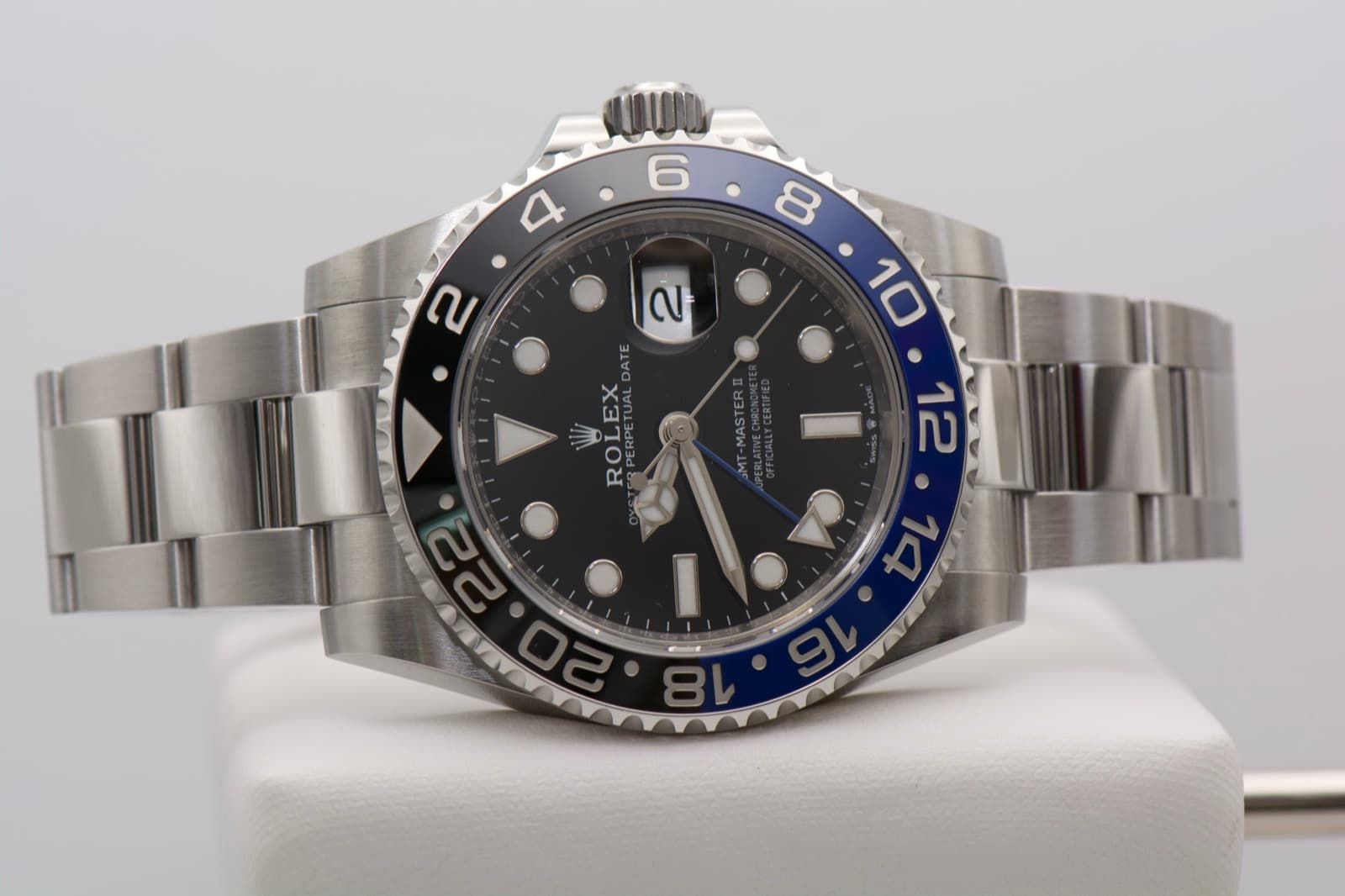
Then check the dial and hands closely. They should be original and unmolested — no refinishing, no swapped service hands, no lume that doesn’t match between the dial and the handset. On modern Rolex, look for the laser-etched crown at six o’clock on the crystal and the engraved rehaut (the inner bezel ring) as part of confirming authenticity. None of this should be hidden from you; a good seller invites the scrutiny.
Box, papers and provenance
A full set — original box, warranty card (or the modern digital warranty), booklets and hang tags — adds confidence and resale value. But the absence of papers isn’t a dealbreaker on the right watch at the right price, provided the piece has been properly authenticated. Plenty of excellent watches have lived full lives and lost their cardboard along the way.
What you should never compromise on is authentication. Never buy a Rolex that hasn’t been verified by someone who genuinely knows them — movement, case, dial and bracelet all checked. That single step protects you from the vast majority of costly mistakes.
Service history and what it means
Ask when the watch was last serviced and by whom. A recent service from Rolex or a reputable independent watchmaker is reassuring; a watch that’s run untouched for fifteen years isn’t necessarily a problem, but it’s a future cost to factor in. Don’t over-index on “unpolished and unserviced” as a virtue, either — originality matters, but a watch is meant to be worn and kept running.
Buy the seller, not just the watch
Finally, buy from someone you can talk to. A good dealer will happily walk you through a watch’s history, answer the awkward questions, let you handle the piece, and give you time to decide. That relationship is worth as much as the watch itself — it’s who you’ll call when you want to service it, insure it, trade it, or find the next one.
If you’d like a second opinion on a specific reference — or want us to find a clean example for you — that’s exactly what we do. Bring us the reference and the budget, and we’ll tell you honestly what’s fair and what to wait for.